Skip to content

Hyphae Light

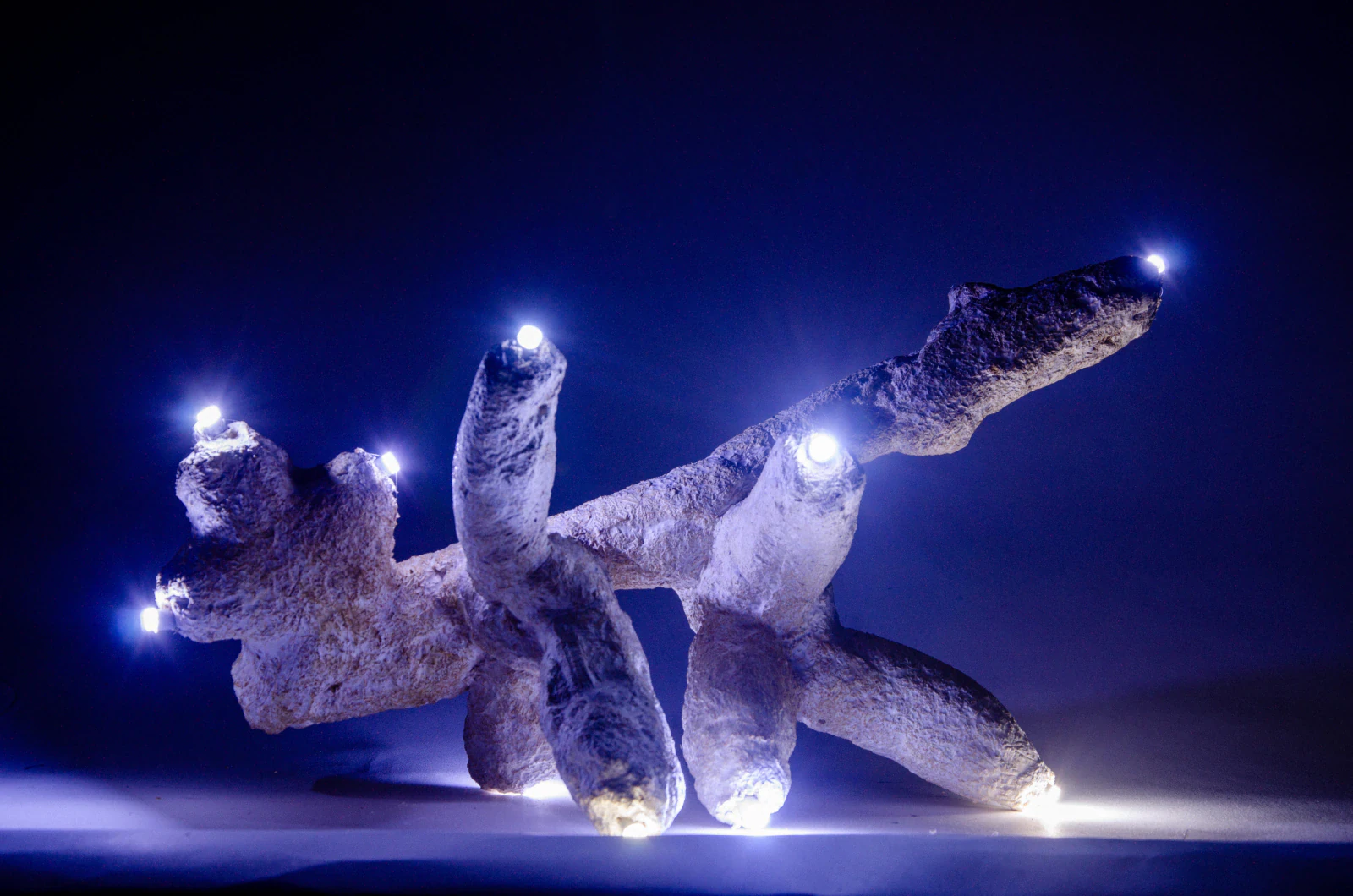
A branching Hyphae sculpture with small lights at its tips in blue light.Hyphae title, summary, project type and date panel. Panel text: Hyphae Type: Material research, Digital modeling, Prototyping Date: 2023 The Hyphae light is a fixture concept modeled on the microscopic growth patterns of mycelium, introducing the future material to users through form.

Hyphae

The Hyphae light is a fixture concept modeled on the microscopic growth patterns of mycelium, introducing the future material to users through form.

Type
Material research · Digital modeling · Prototyping
Date
2023
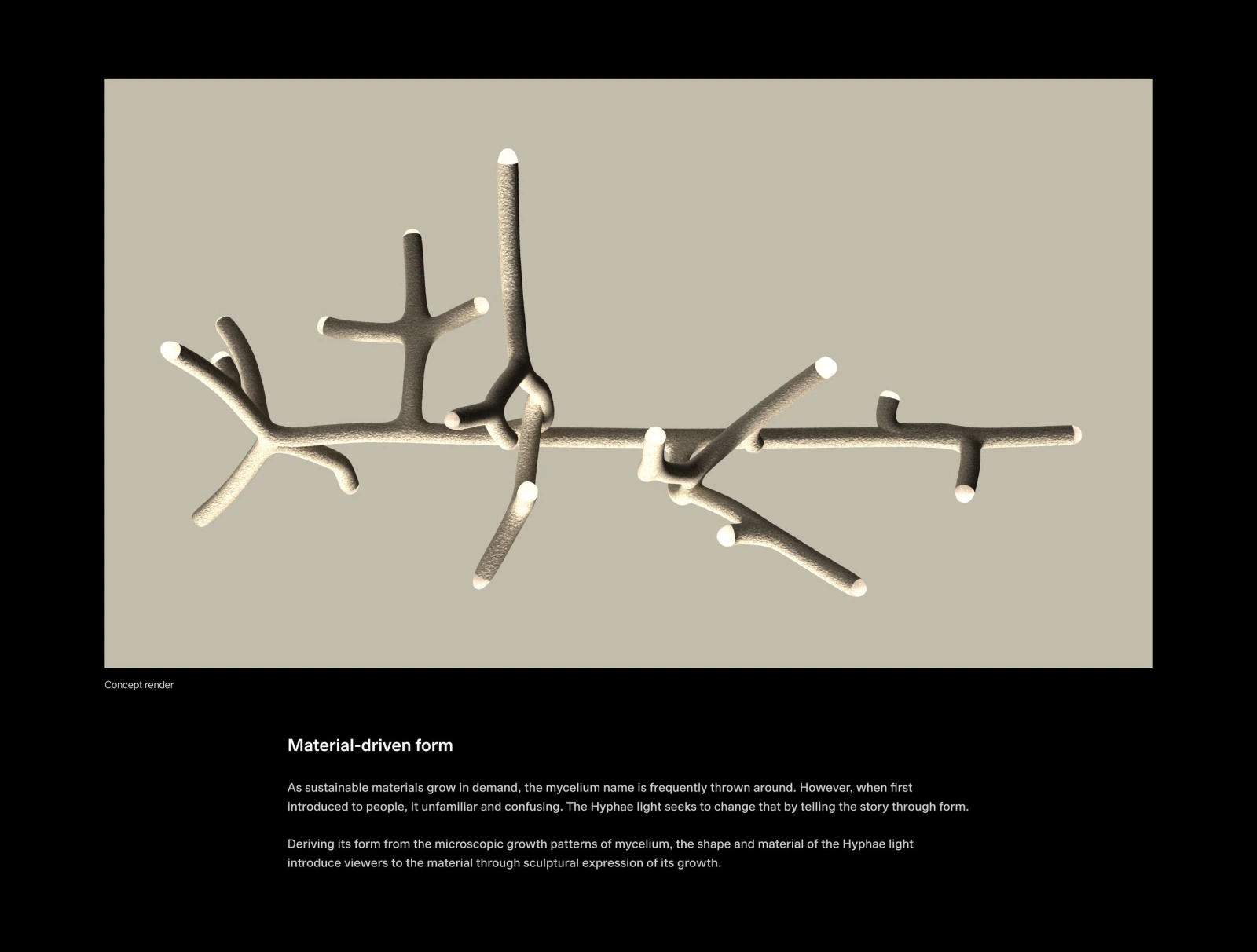
A branching light concept render above the material-driven form description. Panel text: Material-driven form Concept render As sustainable materials grow in demand, the mycelium name is frequently thrown around. However, when first introduced to people, it unfamiliar and confusing. The Hyphae light seeks to change that by telling the story through form. Deriving its form from the microscopic growth patterns of mycelium, the shape and material of the Hyphae light introduce viewers to the material through sculptural expression of its growth.

Material-driven form

Concept render

As sustainable materials grow in demand, the mycelium name is frequently thrown around. However, when first introduced to people, it unfamiliar and confusing. The Hyphae light seeks to change that by telling the story through form.

Deriving its form from the microscopic growth patterns of mycelium, the shape and material of the Hyphae light introduce viewers to the material through sculptural expression of its growth.

Black section divider labelled Background. Panel text: Background

Background

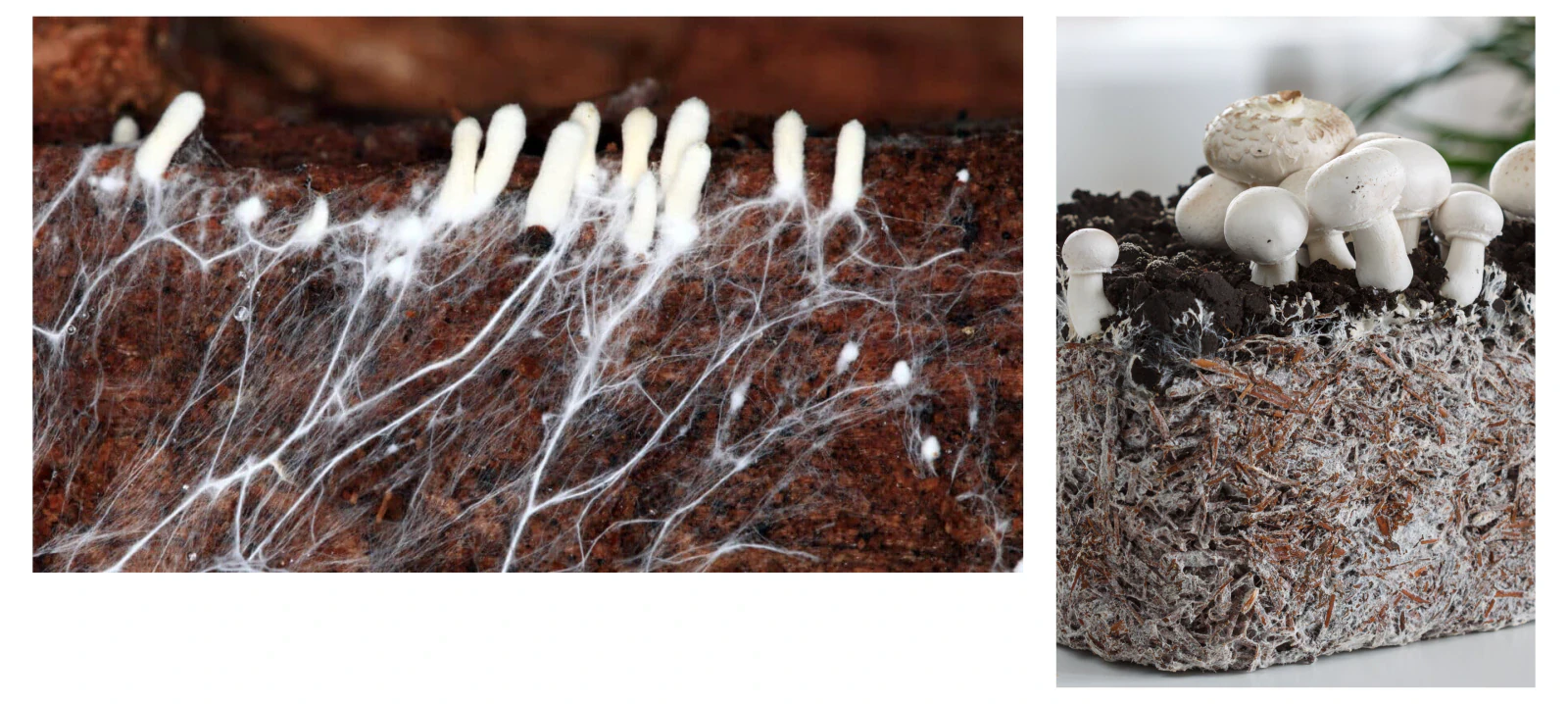
Two photographs showing white fungal strands and mushrooms growing from a substrate.
Text panel explaining mycelium and its use as a composite. Panel text: What is mycelium? Mycelium is the white root system found living in the ground beneath mushrooms. When grown in wood chips, mycelium becomes a material somewhere between styrofoam and MDF, but 100% compostable. The composites sustainability and structure is what has made the design community excited about it.
What is mycelium?

Mycelium is the white root system found living in the ground beneath mushrooms. When grown in wood chips, mycelium becomes a material somewhere between styrofoam and MDF, but 100% compostable. The composites sustainability and structure is what has made the design community excited about it.

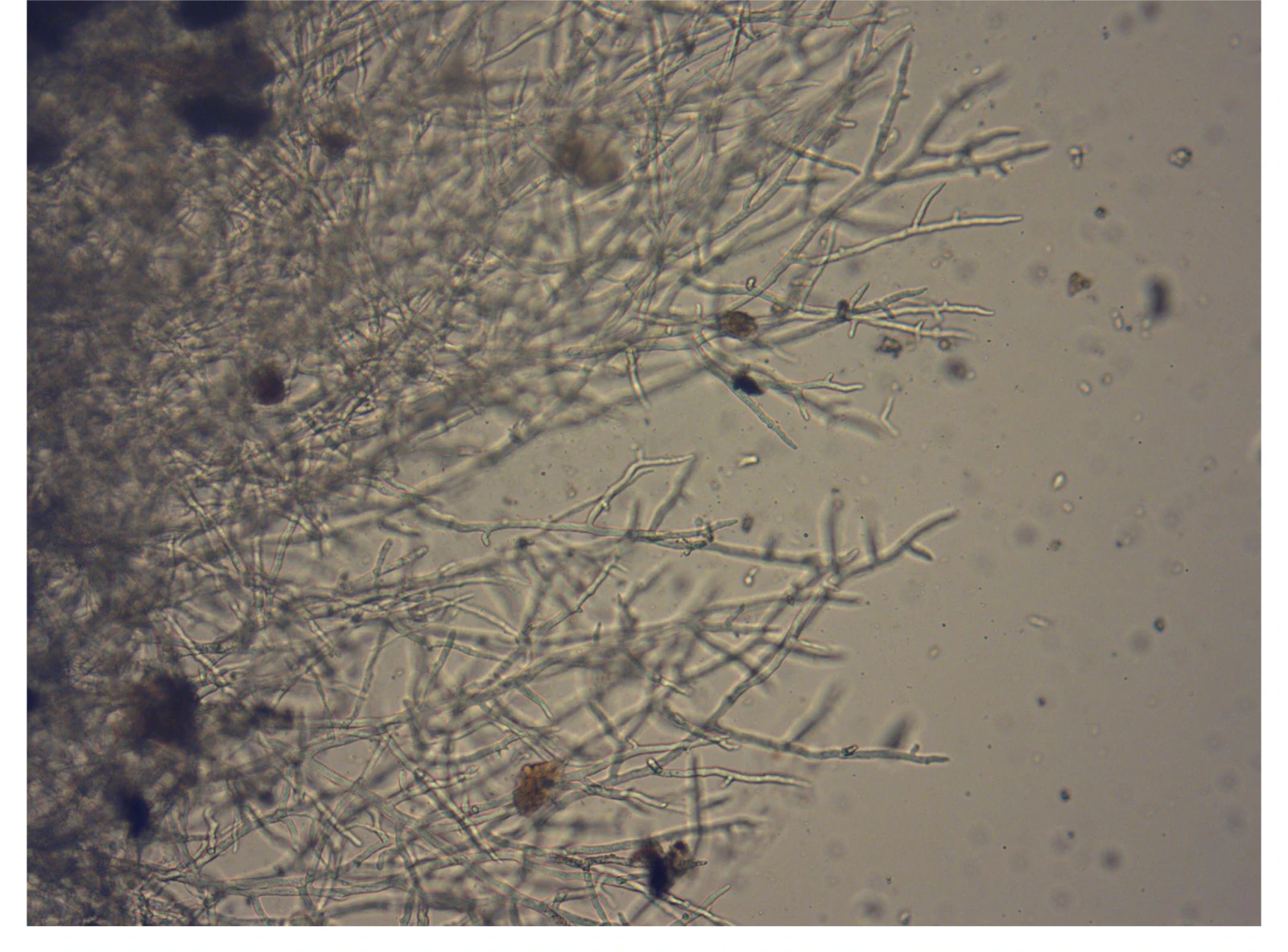
Microscope photograph of branching fungal strands.
Text panel describing hyphae and the project goal. Panel text: Hyphae, the building blocks of mycelium Mycelium is made up of of hyphae, exploring limbs in search of nutrients. Invisibly small, they become apparent to the eye as a mass of white veins after thousands of searching strands overlap. Mycelium is alien on first encounter. It's a spongy membrane of velvety white material, spotted with stains of what look like mold growth. Introducing its to a consumer landscape made of plastics and metals is confusing. By telling the story of hyphae growth through sculpture, I hope to familiarize consumers with this future material. This projects goal is to introduce mycelium material to consumers.

Hyphae, the building blocks of mycelium

Mycelium is made up of of hyphae, exploring limbs in search of nutrients. Invisibly small, they become apparent to the eye as a mass of white veins after thousands of searching strands overlap.

Mycelium is alien on first encounter. It's a spongy membrane of velvety white material, spotted with stains of what look like mold growth. Introducing its to a consumer landscape made of plastics and metals is confusing. By telling the story of hyphae growth through sculpture, I hope to familiarize consumers with this future material.

This projects goal is to introduce mycelium material to consumers.

Black section divider labelled Process. Panel text: Process

Process

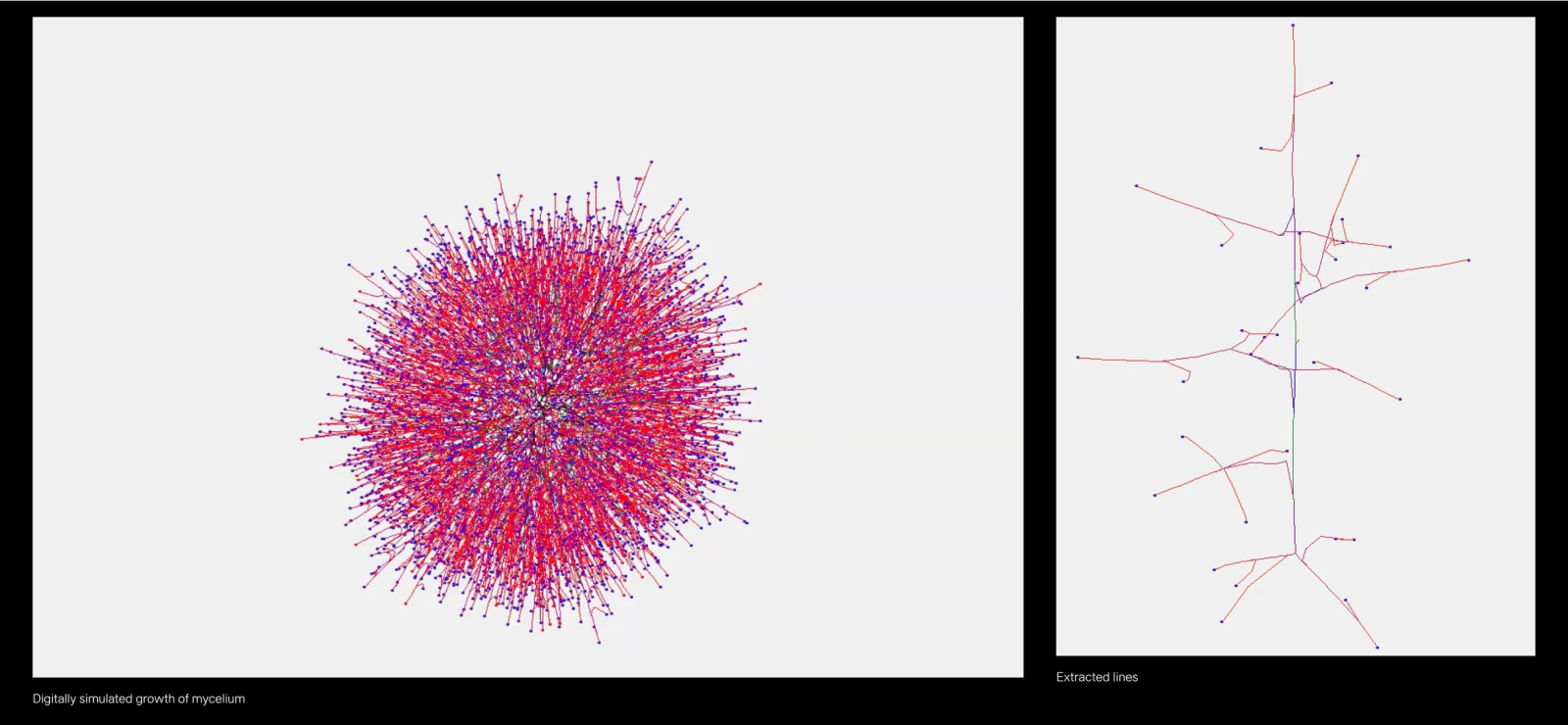
Two digital models of branching growth, one dense and one sparse. Panel text: Digitally simulated growth of mycelium Extracted lines

Digitally simulated growth of mycelium

Extracted lines

Text panel describing the transition from growth simulation to sculptural form. Panel text: Extracting form from nature To tell the story of mycelium, I wanted to reveal the microscopic growth patterns to consumers. There is beauty in the growth that I felt viewer would resonate with, if it could be shown at a larger scale. My plan was to extract the shape from early growth stages, turn that into a 3d model, and make that into a sculptural lighting fixture. By using Mycologist David Moore's cyberfungi algorithm, which simulates accurate mycelium growth, I was able to create a true to nature digital model. From that digital growth model, I extracted a set of lines which I translated into a 3D model.

Extracting form from nature

To tell the story of mycelium, I wanted to reveal the microscopic growth patterns to consumers. There is beauty in the growth that I felt viewer would resonate with, if it could be shown at a larger scale. My plan was to extract the shape from early growth stages, turn that into a 3d model, and make that into a sculptural lighting fixture.

By using Mycologist David Moore's cyberfungi algorithm, which simulates accurate mycelium growth, I was able to create a true to nature digital model. From that digital growth model, I extracted a set of lines which I translated into a 3D model.

Black section divider labelled Prototype. Panel text: Prototype

Prototype

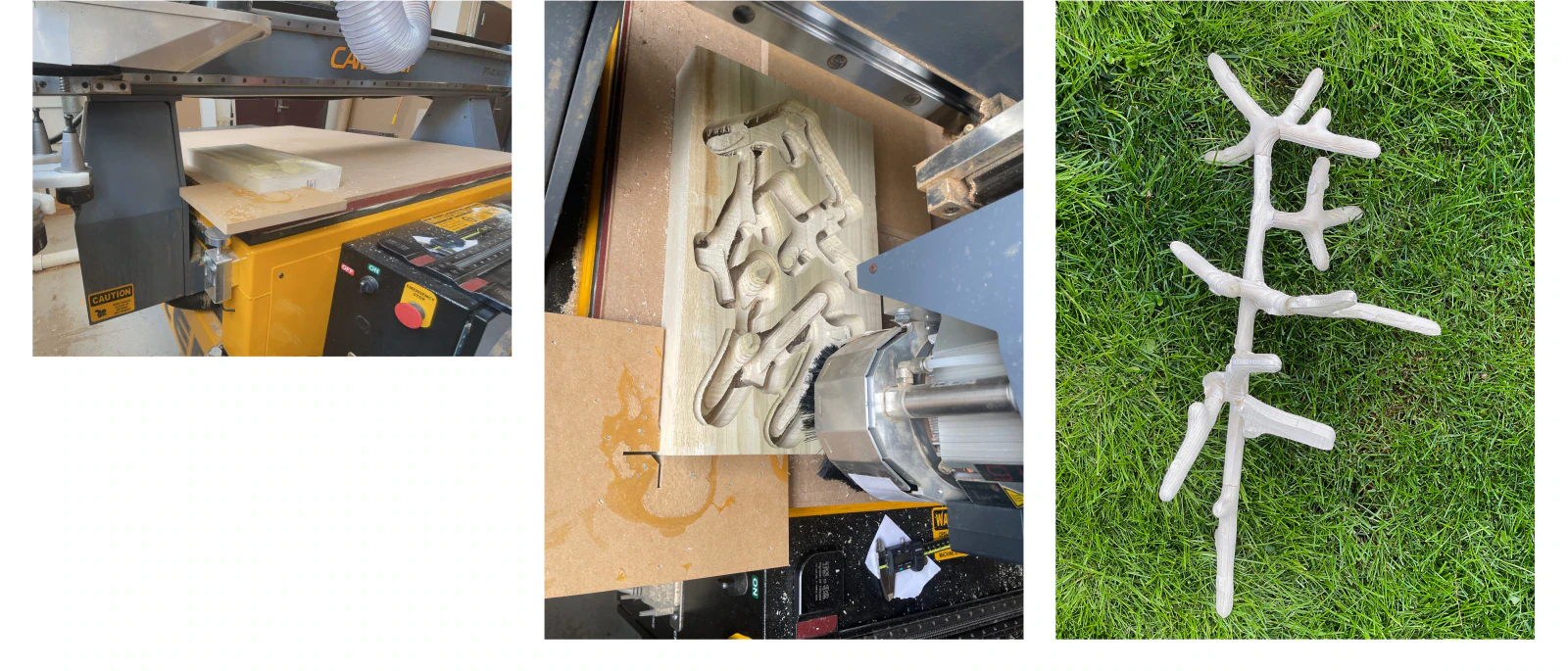
Collage of wood being cut and a white branching skeleton resting on grass.
Text panel describing construction of the skeleton. Panel text: Making the skeleton To make my digital model into a real mycelium-coated prototype, I split the shape up into parts which I could CNC, then glue together. Wood would allow the mycelium root-structure to grow into the skeleton material, creating strength.

Making the skeleton

To make my digital model into a real mycelium-coated prototype, I split the shape up into parts which I could CNC, then glue together. Wood would allow the mycelium root-structure to grow into the skeleton material, creating strength.

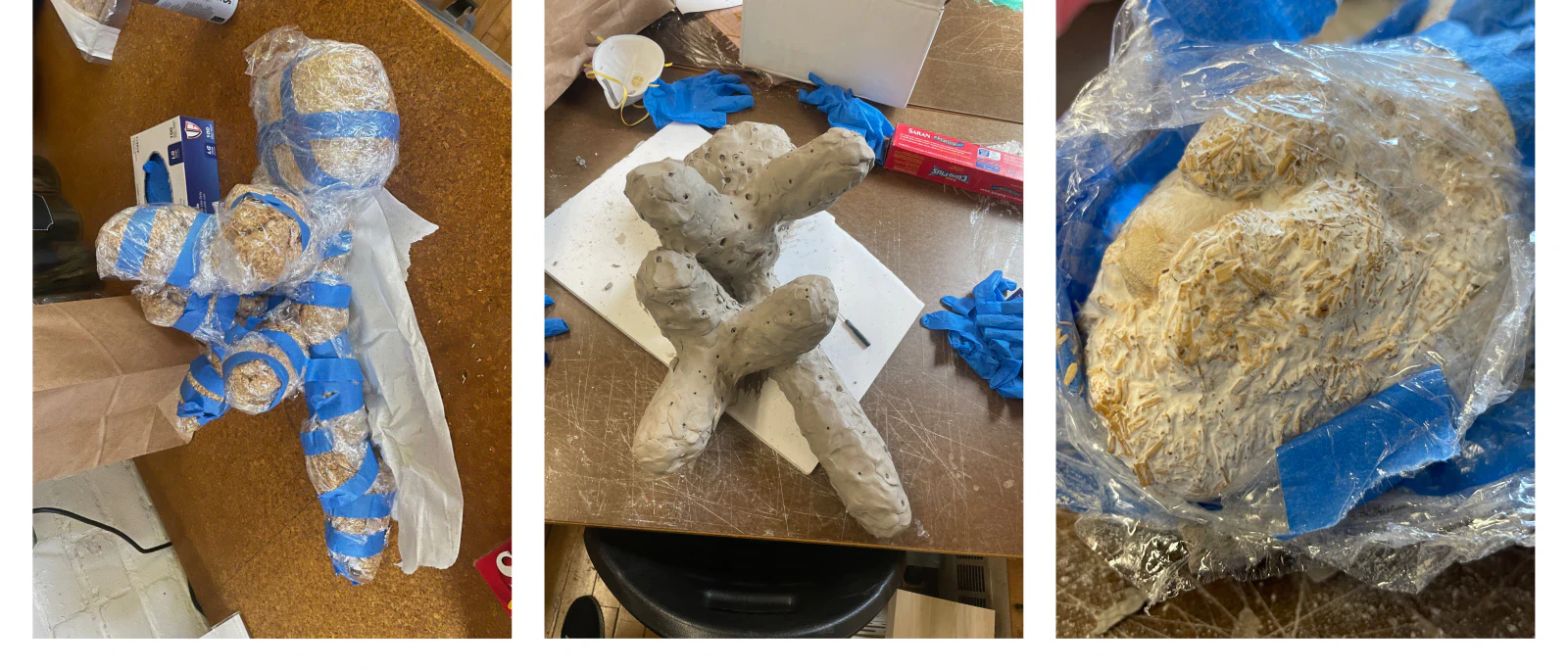
Photographs of the branching skeleton wrapped with substrate and the exposed growth.
Text panel describing the mycelium growing process. Panel text: Growing mycelium I surrounded the skeleton with living mycelium composite, and used saran wrap to secure the loose chips. Then, I covered the model in clay, poked holes, and hydrated it. That convinces the living material that it is underground and gets it to grow. After five days, I unwrapped the prototype to reveal healthy mycelium growth. Hyphae can be seen growing within the wooden skeleton.

Growing mycelium

I surrounded the skeleton with living mycelium composite, and used saran wrap to secure the loose chips. Then, I covered the model in clay, poked holes, and hydrated it. That convinces the living material that it is underground and gets it to grow.

After five days, I unwrapped the prototype to reveal healthy mycelium growth. Hyphae can be seen growing within the wooden skeleton.

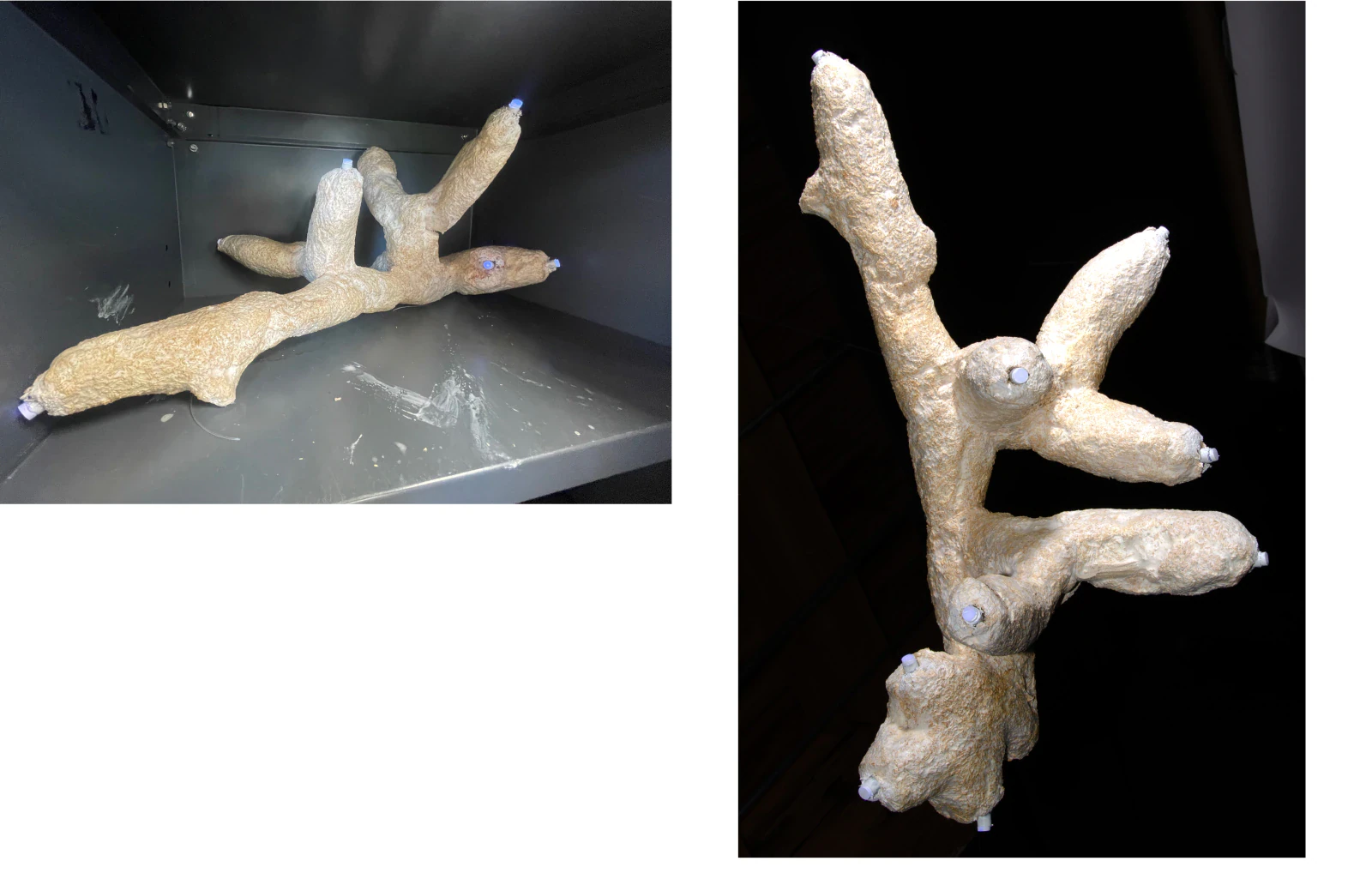
Two photographs of the branching prototype with small lights attached.
Text panel describing the finishing steps. Panel text: Finishing Lights were attached to the ends of the hyphae, indicating that the organism grows from these points. Finally, the mycelium was left out to dry, stopping growth from advancing but not killing it.

Finishing

Lights were attached to the ends of the hyphae, indicating that the organism grows from these points.

Finally, the mycelium was left out to dry, stopping growth from advancing but not killing it.

Hyphae title on a dark blue background. Panel text: Hyphae
Hyphae

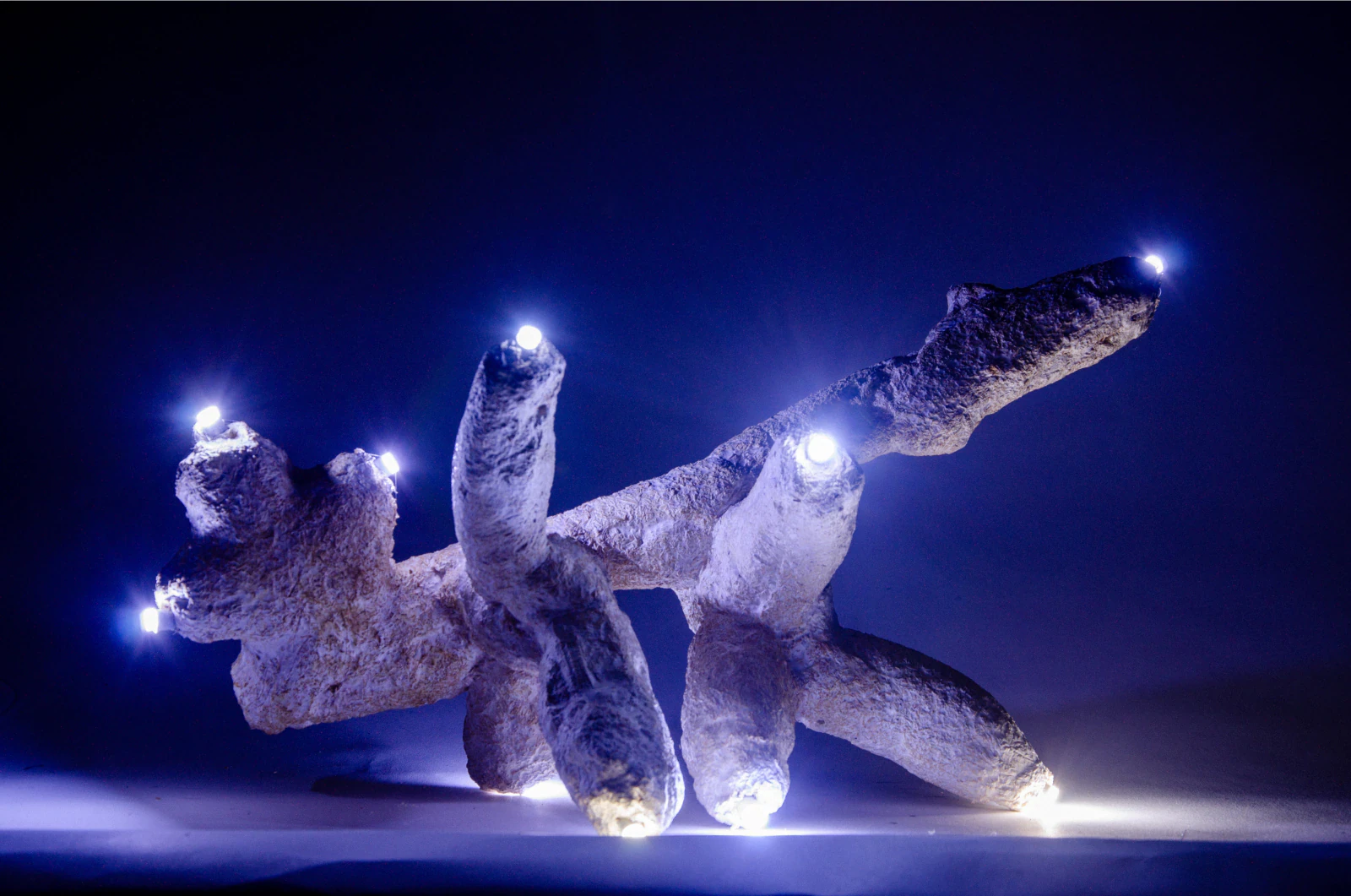
The finished branching light sculpture photographed in blue light.
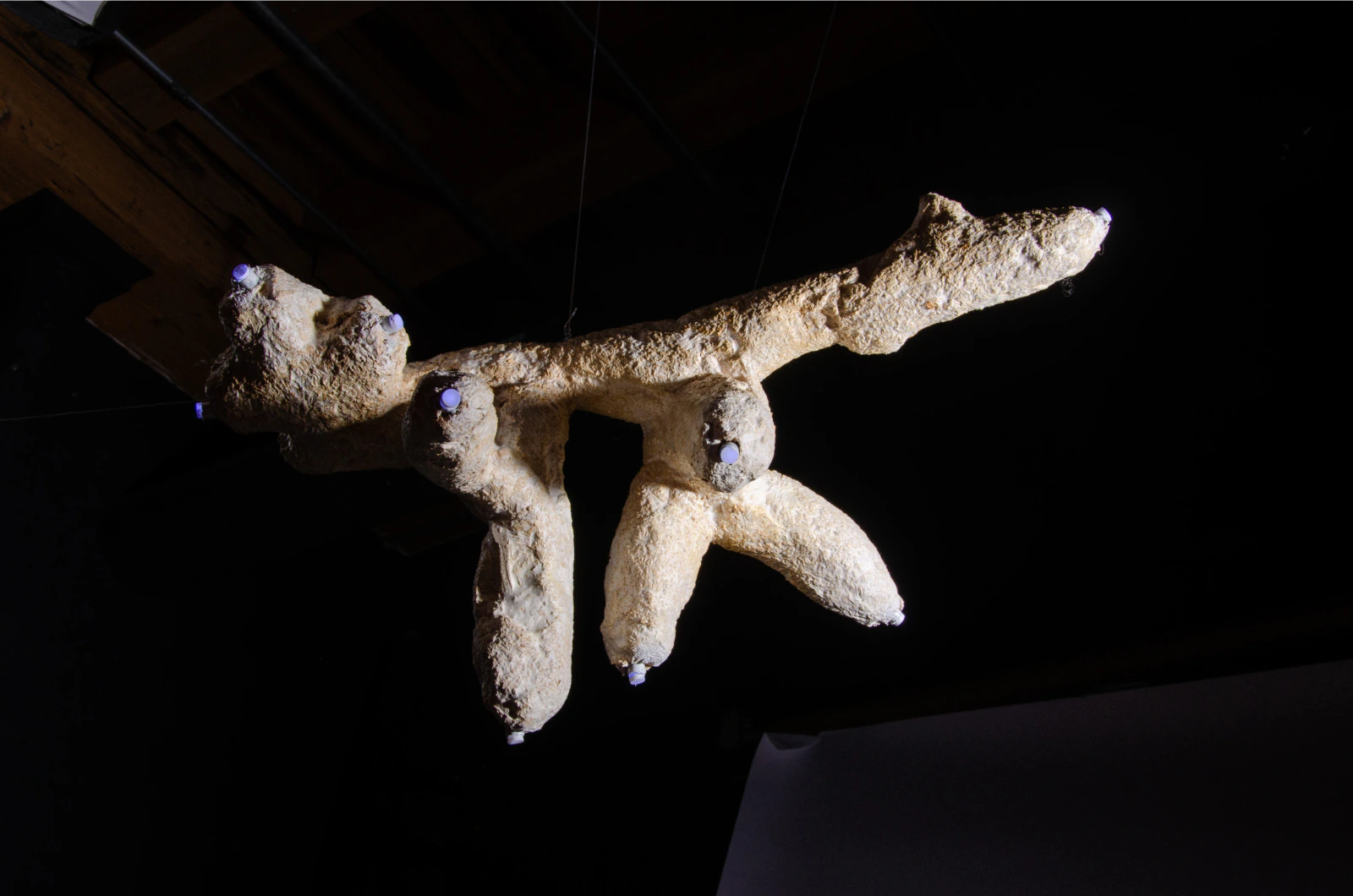
The Hyphae light suspended against a dark background.
Text panel relating the sculpture to microscopic growth. Panel text: The sculpture accurately represents the microscopic growth happening within mycelium. Each limb splits when actual mycelium would split, with lights indicating where the tendrils look to continue growth.
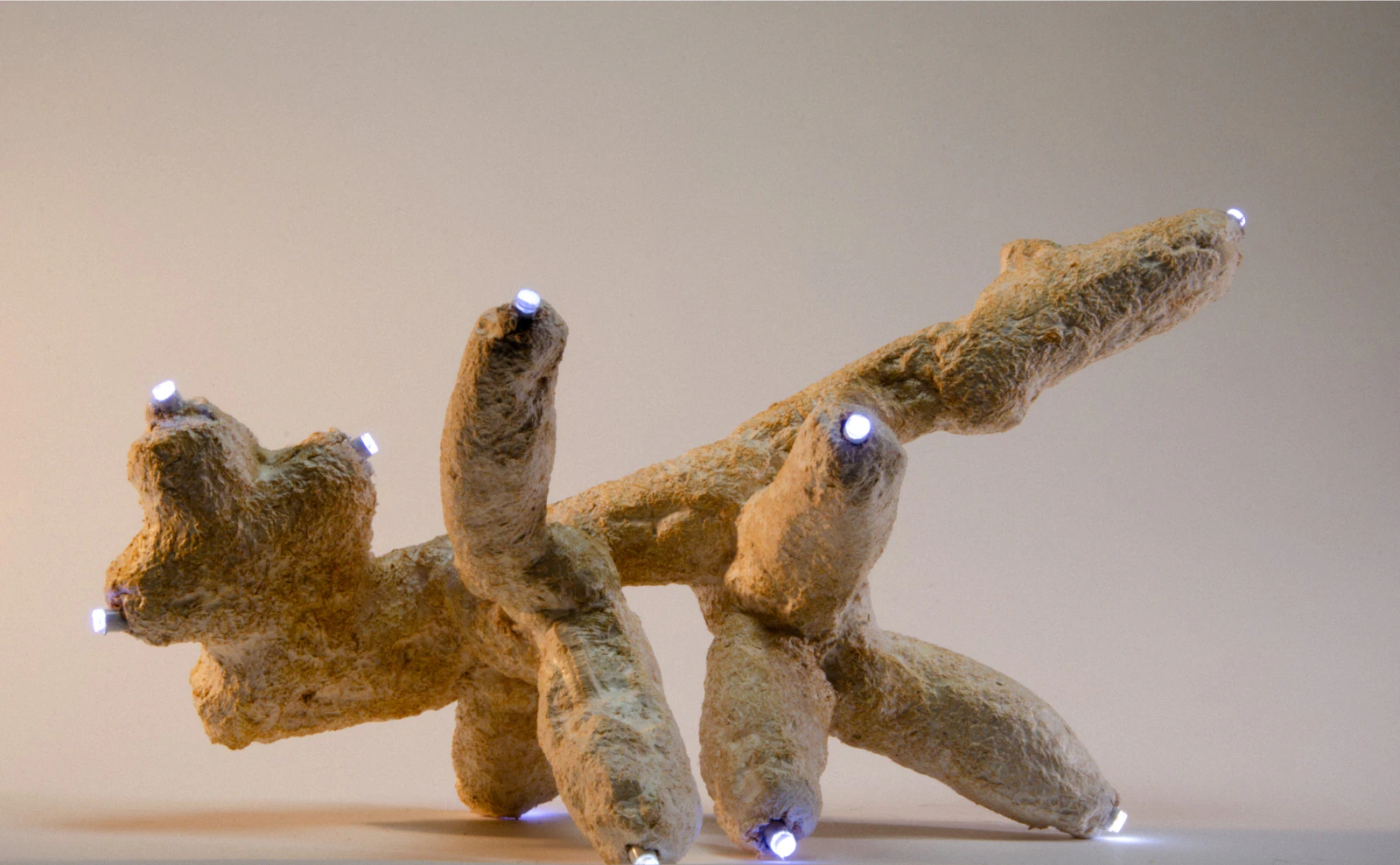

The sculpture accurately represents the microscopic growth happening within mycelium. Each limb splits when actual mycelium would split, with lights indicating where the tendrils look to continue growth.

The branching Hyphae light standing against a pale background.
Closing text panel describing possible further iterations. Panel text: Next steps Though the model was executed effectively, considering its 2 week production period, it leaves a lot to be desired. In further iterations, I would primarily focus on production methods and also implement a more realistic lighting system. I would explore using a latex mold to grow the mycelium. That would allow me to better define limits of the growth and a less intense skeleton. I also plan on exploring an internal lighting harness, allowing power from one source to route to lights on each end.

Next steps

Though the model was executed effectively, considering its 2 week production period, it leaves a lot to be desired. In further iterations, I would primarily focus on production methods and also implement a more realistic lighting system.

I would explore using a latex mold to grow the mycelium. That would allow me to better define limits of the growth and a less intense skeleton. I also plan on exploring an internal lighting harness, allowing power from one source to route to lights on each end.